River, coast, and frontier
Land & people
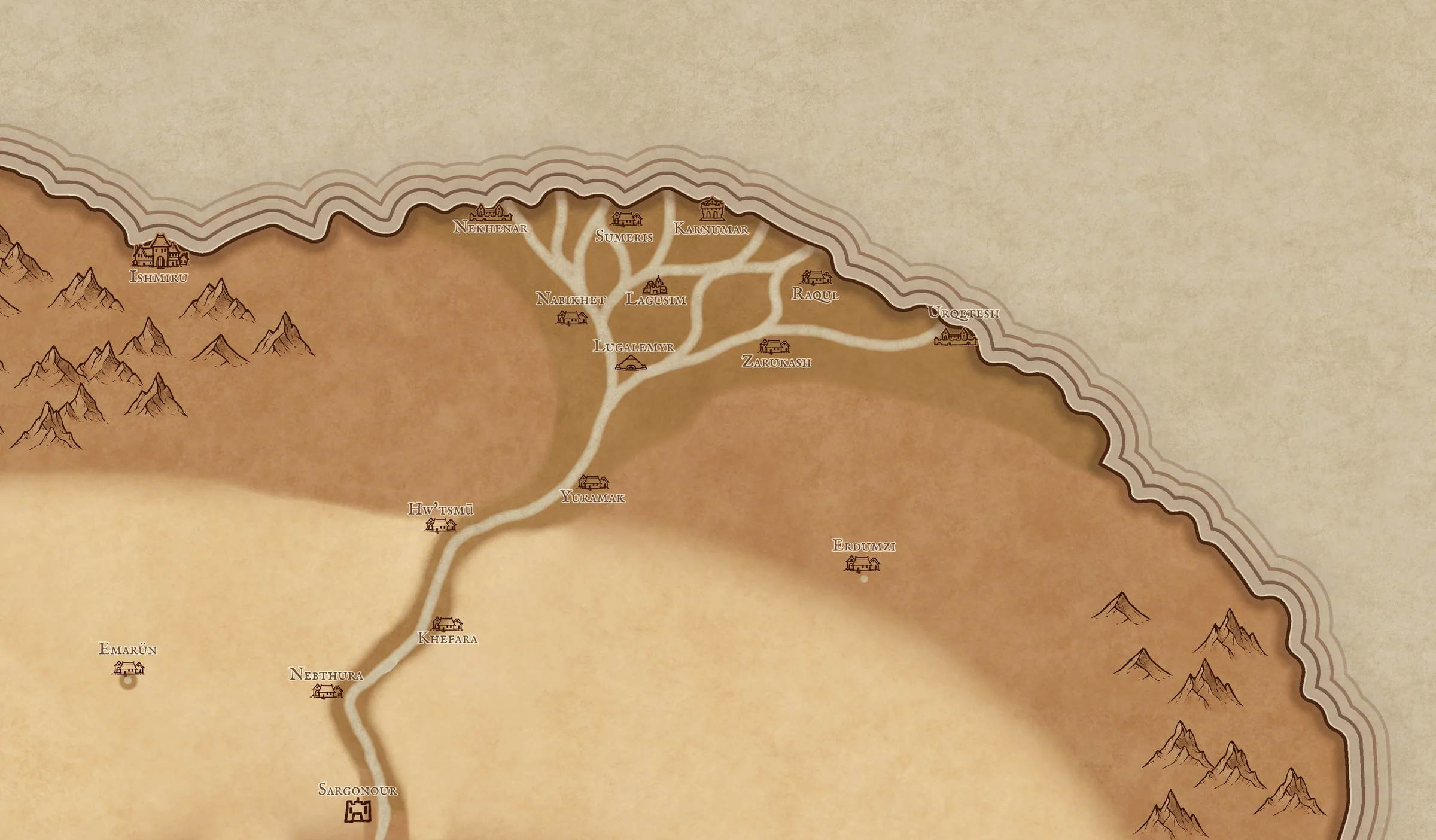
The Khemara is Murisium’s lifeblood. Its waters sustain the settled river country and the irrigated land on which agriculture, transport, and city life depend. Rivers and cultivated ground are therefore at once practical infrastructure and objects of reverence.
Beyond the watered country, heat and dry land shape travel and settlement. Rains can arrive with flooding and violent winds; between them, the climate is hot and arid, with dangerous sandstorms. The coast, mountain country around Ishmiru, and the southern border all give the country different outward faces.
Tabaxi nobility supplies the pool from which the Lugalen is chosen. Across Murisium, the most visible distinctions in public life arise from the differing work of river towns, temple precincts, courtly centers, ports, military posts, and the mountain-and-coast country.
City and institution
Society & culture
Murisian public life is strongly urban and institutional. At Lugalemyr, palaces, gardens, temples, ziggurats, and monuments mark the presence of the royal and aristocratic order. Elsewhere, great temple complexes and administrative offices make religion and government visible in the everyday work of the state.
River life, military service, commerce, priestly authority, and bureaucracy all carry public weight. Regional differences matter: the capital’s aristocratic world differs from the offices of Lagusim, the martial concentration at Karnumar, the maritime character of Nekhenar and Urqetesh, and the more self-sufficient mountain-and-coast country around Ishmiru.
Crown, priesthood, and command
Government & power
The Lugalen
Murisium’s ruler bears the title Lugalen. The office is chosen from a pool of tabaxi nobility, confirmed by a college of high priests, and understood to carry a direct relationship to Murisel, the Sovereign Protector.
Lugalemyr & Lagusim
Lugalemyr is the royal and aristocratic capital. Lagusim is the chief administrative center, where major temples also serve the practical work of government and bureaucracy.
Karnumar
Karnumar is the principal center of Murisian military power, concentrating soldiers, warships, and major weapons under the authority of the state.
Water, mineral, and sea
Economy & trade
River agriculture and the traffic it supports are the foundation of Murisian economic life. Nekhenar and Urqetesh are the major ports; Nekhenar carries much of the documented trade with Lithaea, making it an important link between the Khemara country and the Bakalatu Sea.
Ishmiru, a semi-autonomous protectorate, is an important source of precious metals and minerals. Its mountain-and-coast position, relative self-sufficiency, and mineral wealth give it a distinct role within the country.
Murisium also maintains controlled firearms production. Giff engineers first developed gunpowder weapons as cannons; over time, this work was refined into flintlock muskets. Those weapons remain regulated by Murisian authorities rather than serving as ordinary commercial goods.
The river and its guardians
Religion
Murisel
Murisel, the Sovereign Protector, is Murisium’s national deity and is closely bound to the sacred authority claimed by the Lugalen.
Twüleýa
Twüleýa is especially revered as Mother of the Khemara, whose waters give the country its life and substance.
Other observance
The wider Imïré pantheon is known in Murisium through local traditions. Dirilüma is held in high esteem; Günanára and Diriaý are respected; Yildirym is feared for destructive weather; and Adaghan has a more marginal following among desert wanderers, caravanners, and around Ishmiru.
Cities, ports, and frontier posts
Major settlements
Capital
Lugalemyr
The royal and aristocratic capital, marked by palaces, gardens, temples, ziggurats, and monuments.
Administration
Lagusim
The main administrative center, where great temple complexes are also the working offices of the bureaucracy.
Military center
Karnumar
The concentration point for soldiers, warships, and major state weapons.
Lithaean port
Nekhenar
A major port and the principal documented channel of Murisian trade with Lithaea.
Port
Urqetesh
A second major port on Murisium’s maritime routes.
Southern frontier
Sargonour
A fortified military town that maintains Murisium’s southern border with the desert beyond.
Protectorate
Ishmiru
A largely self-sufficient, semi-autonomous protectorate and an important source of minerals and precious metals.
River civilization and regulated force
History
A Khemara-centered state
Public tradition remembers a long development of Murisian civilization around the Khemara, its river settlements, temple life, and the institutions that came to govern water, land, and public order.
The Crocodile Wars
The Crocodile Wars are remembered as a period of river danger and martial organization. Their legacy is associated with the growth of Murisium’s martial and religious culture.
Firearms and regulation
Giff engineers developed gunpowder weapons beginning with cannons, later refining them into flintlock muskets. State regulation has remained central to their production and use. A Murisian musket was later stolen and smuggled into Lithaea, where it helped inspire illicit experimentation.
Across the Bakalatu Sea